As a music lover, I'm all for a
movie that has an original soundtrack. However, the movie isn't always about
the soundtrack; in most movies with original scores, the score isn't the first
thing most people would think of. Star
Wars, Lord of the Rings, and Harry Potter all have original soundtracks
(phenomenal original soundtracks), but the movie isn't about the music.
And that's where La
La Land (2016) is so
different from most movies with great music, because this movie is about the music, the art.

The first shot of the movie is
one of the most astoundingly theatrical cinematic moment’s I’ve ever seen; When
the cheery opening number begins, a cast of nameless faces proclaim that “even
when the answer’s no or when my money’s running low…it’s another day of sun.”
The optimism is so overdone that
you already feel as if this movie is NOT going to end in happy tears.
After the setting is established,
we get to know the main characters, Sebastian and Mia, played by Ryan Gosling
and Emma Stone, respectively. Sebastian is a jazz pianist and jazz purist who
wants to open his own jazz club, and Mia is an actress who wants to be a part
of something profound. Of course, they fall in love.
 |
| src |
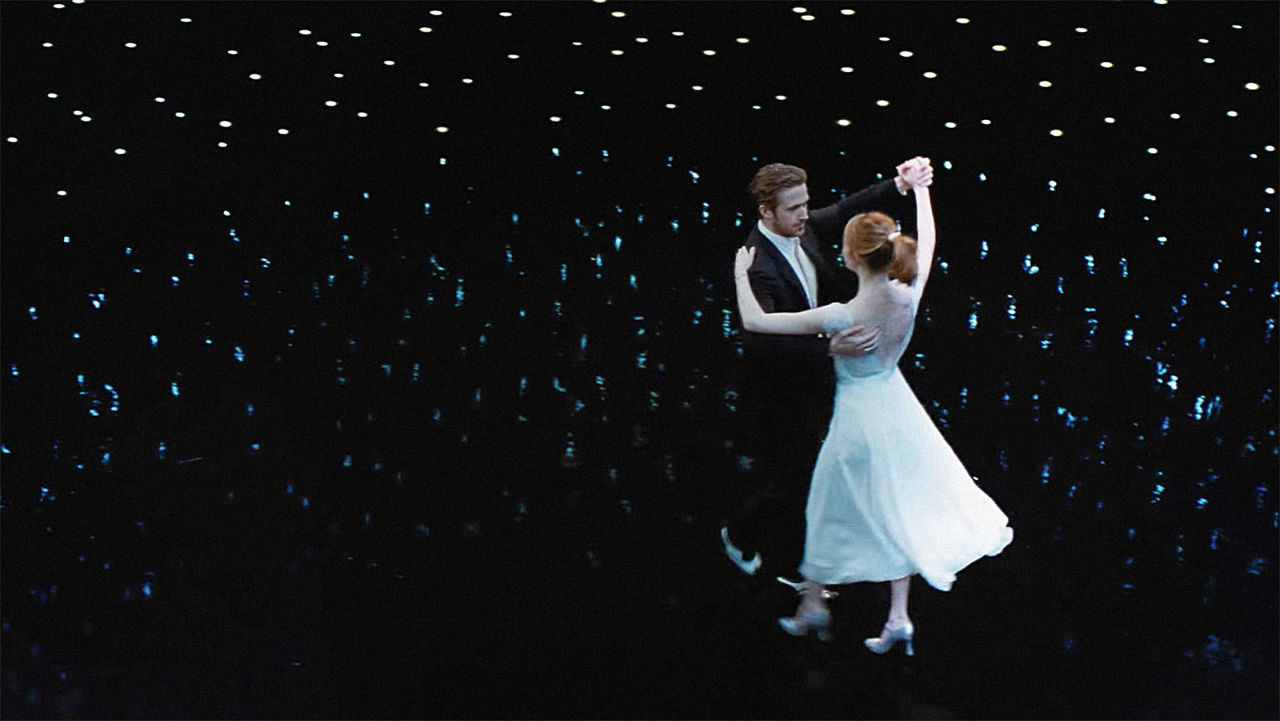
It’s the typical sweeping
romance; they meet by chance a few times before connecting and they play mutual
cat and mouse for a while.Their
fall is beautiful, surrounded by stars in the planetarium and by an incredibly
full and moving score. All music up to this point has been upbeat and cheery,
in major keys and at moderately fast tempos.
Then suddenly, we feel a kernel of doubt from Sebastian in the haunting melody of “City of Stars.” The sudden introduction of a slow, somber melody is masterful in advancing the plot and in revealing the final outcome of the narrative. Sebastian doubts that he can make things work with Mia: “Is this the start of something wonderful and new? Or one more dream that I cannot make true?”
And this kernel of doubt will ultimately be his hamartia. In a moment of weakness, he agrees to go on tour with a progressive jazz band and, in his absence, fails to support Mia in the pursuit of her dreams.
Eventually, though, Mia does catch her own break, but must go to France to pursue her dream. Where most of Mia and Sebastian’s scenes have been scored throughout the movie, their breakup scene is tragically silent, and ends with a mutual “I’m always gonna love you.”
 |
| src |
Overall, I’d say it was an incredible movie, and I think the most astounding thing about the score is that the majority of the music is just an extrapolation of three core melodies.
The burning questions: Is it worth it to sacrifice love and self for the pursuit of one’s dream? Do you think Mia and Sebastian made the right decisions? Are sad movies more poignant because life is inherently sad (that’s a heavy one)?
Next time: Another Damien Chazelle film about music, Whiplash.
