Thursday, February 23, 2017

Bluegrass, Banjos, and Bullfrogs


Again switching it up this week, I'm going to talk about the Coen brother comedy O Brother, Where Art Thou?

The cult classic from 2000 is loosely based on Homer's The Odyssey. The movie follows Everett and his companions, Pete and Delmar, after they escape from prison in search of a 1.2-million-dollar treasure.
Clooney is Everett, Delmar is on the left, and
Pete is on the right. (src)

The movie loosely follows the plot of The Odyssey in that Everett escapes prison to journey home to his wife and win her back. Along the way, the boys meet a blind prophet, a pseudo-cyclops, and sirens, just like in Homer’s epic tale.

Overall, the movie is more of a comedy than anything else, with a litany of quotable quotes, such as:

“Those boys desecrated a burning cross!”

“The preacher says all my sins is warshed away, including that Piggly Wiggly I knocked over in Yazoo.”

“Shake a leg Junior! Thank God your mammy died givin' birth. If she'd have seen you, she'd have died o' shame.”

With this movie, I can’t really get too much into the plot without spoiling the whole thing or any of the jokes, and, if you’ve read The Odyssey, you kind of already know how the movie is going to go.

Keeping that in mind, I’ll just move on to the soundtrack, which is really, really good.

This is one of the most successful soundtracks I’ve ever heard in terms of establishing a tone from the get-go. The first scene is the prisoners breaking up rocks for the railroad; the prisoners are singing “Po Lazarus,” a traditional song. The song is sung a cappella in a nod to the chorus in Greek dramas.

The KKK scene is pretty scary. (src)
A lot of the music in the film is sung a cappella; a chorus alone sings “Down to the River to Pray” during a baptism scene, the sirens sing “Didn’t Leave Nobody but the Baby” without accompaniment when they seduce the trio, and the entire KKK scene is accented by the haunting chants of a men’s choir. The film even ends with an a cappella song, “Angel Band,” sung by Everett’s many children and the blind prophet.
This heavy use of vocal music without accompaniment creates an almost timeless effect and also nods to the simplicity of the lives of the characters.

All of the other music is quintessential bluegrass and folk. The first instrumental track we hear is Harry McClintock’s "Big Rock Candy Mountain.” This almost sickly sweet tune plays over the prisoners’ escape, creating a comedic feel right from the get-go.

But if there’s one track from this move that’s infamous, it’s the Soggy Bottom Boys’ "I Am a Man of Constant Sorrow." Not only is this a good song in and of itself, it’s also perfect for this movie. The song’s lyrics are undeniably dismal, and if you looked at them without hearing the song, you’d probably think it was a slow ballad. But the song is actually a super-upbeat bluegrass tune; this makes it almost comical, and it reflects the dark comedy of the film itself.

What do you think? Should I have stayed up until 4am to write this? Do you like Greek epic poems? Am I in class today? Do you like bluegrass?

Here's the whole soundtrack if you would like to listen: https://www.youtube.com/watch?v=HIXbh-VhaFg


Wednesday, February 15, 2017

You've Got to Be Akira-ding Me (I'm Running Out of Puns and I'm Sorry)

So first of all, I'm sorry guys, but I didn't watch any of your suggestions. I decided to go really off of my usual theme this week; so far, I've been writing about live-action American dramas from this millenium, but this week I decided to watch an animated Japanese sci-fi movie from 1988. So buckle up, because this is going to be a lot different from usual.

Akira doesn't have a single CGI frame, filled from beginning to end with
stunning, hand-drawn visuals. (src)
This week, I watched Akira, a cult favorite anime that set the standard for the genre in decades to come. Its stunning visuals and heavy thematic content make it a landmark film in any genre, influenced by such iconic films as 2001: A Space Odyssey and Blade Runner.

Akira opens on Tokyo in 1988 as it is being consumed by a nuclear blast, the nuclear blast that ultimately ended World War III. The story truly begins in 2019, in the dystopian Neo Tokyo, where biker gangs rule the streets and anarchy seems to be the norm.

We meet the two main characters, Tetsuo and Kaneda, in a hole-in-the-wall bar. The characters in this movie aren't particularly compelling; both guys grew up in a society that didn't really care to improve them. Both of them are tough guys, but Kaneda's always been cooler and tougher, and within the first ten minutes we find out that the driving force for the movie will be Tetsuo's fear of inadequacy.
Tetsuo (bottom) and Kaneda are at odds throughout Akira (src).

Through a complex and choppy series of scenes, we are introduced to the full cast of characters, which includes a mysterious rebel girl, some mutant children, and an overtly macho military man who is concerned at the stagnation of Neo Tokyo's resurrection. I'll spare you the details, because there are a lot of them, but as expected, the government is up to no good, and they're mutating orphans to try to awaken the innate power in human beings. It's sci-fi at its best.

Since I strongly encourage that you watch this movie, along with Blade Runner and 2001: A Space Odyssey, I won't give away the ending or the important plot points, but I will say that if you've ever watched the other two movies, the feeling at the end is pretty much the same in that you will sit with your mouth open for a half an hour, as confused as you are enraptured.

But! Since this is music and the movies, I'd better talk about the music.

I think the most interesting thing about this soundtrack is that it's often at odds with the content it underlies. Akira's soundtrack is worlds different from the other soundtracks I've talked about; it is originally scored, just like Whiplash and La La Land, but it's not jazz, and it's certainly not show tunes.

The majority of the tracks in the soundtrack are ethereal; they don't necessarily stick to any sort of consistent time signature and none of them are in a major key for any long period of time. In fact, and I'm about to get technical, most of them are in a hepta- and pentatonic scale typical of eastern Asian traditional music.

Almost all of the tracks rely heavily on rhythmic percussion and haunting choral chants, giving the entire film a primal feel indicative of the central themes of the narrative. The juxtaposition of syncopated rhythmic percussion and chanting with the lights and futuristic feel of Neo Tokyo creates a tense overtone throughout the movie.

Overall, the movie is a real trip, and I'd definitely recommend it.

The burning questions: Do you like sci-fi? Do you think it's effective as a mode of societal commentary, despite its atypical content? Do you like anime? What movie should I watch next (no promises)?

PS-I could say a lot more about this soundtrack, but I don't have the space here. Here's the soundtrack and, as a bonus, a Kanye West music video that is dedicated to Akira (it's his favorite movie).

Wednesday, February 8, 2017

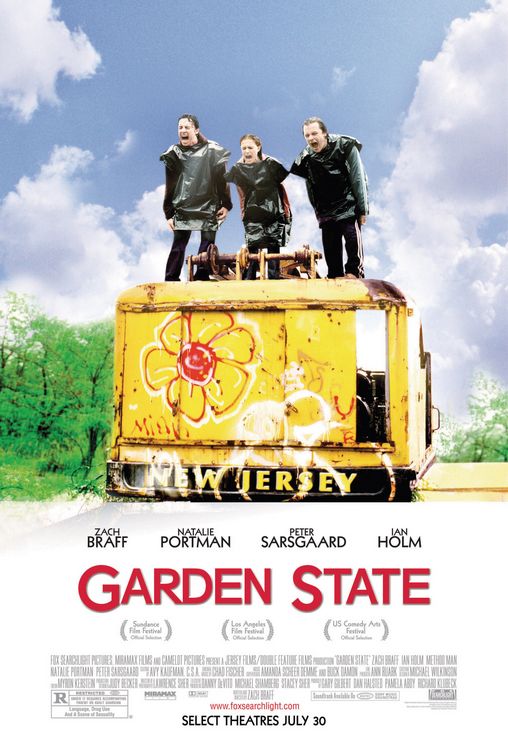
Garden State: Indie AND Goodie

This week's movie is Garden State (2004), and no, it was not directed by Damien Chazelle like the previous two movies I've talked about. This one is actually written, directed, and starred in by Zach Braff (you know him best from Scrubs). 

We begin the film on a crashing plane, with Zach Braff as Andrew Largeman sitting calmly amongst the chaos, seemingly unbothered and possibly bored. We find out it’s a dream when he’s awoken by the ringing of a phone, which he ignores; it’s his dad, and he leaves a stinted message informing Andrew that his mother has died. Not surprisingly, no reaction from Andrew.

We then follow Andrew to a crappy-looking Thai restaurant in an LA suburb to the sounds of Coldplay’s “Don’t Panic,” the lyric ‘we live in a beautiful world’ darkly and comically juxtaposed against the dull concrete of LA and the even duller expression on Andrew’s face.

Garden State's subtle humor allows the film to be  dark without
getting bogged down in pessimism. (src)
We then cut to Andrew standing stoically at his mother’s funeral as an overtly Jewish aunt sings an interesting interpretation of Lionel Richie’s “Three Times a Lady,” which is undeniably hilarious. We learn from the same aunt that Andrew hasn’t been home in 9 years. When his dad says that they need to talk, he just agrees, but then leaves.

The movie up to this point has painted a grim picture of Andrew; one of the most upsetting moments is when he’s at a party, high on ecstasy, and he just sits there as “In the Waiting Line” plays monotonously. An objectively attractive woman even mounts him during a game of spin the bottle, and we have to painfully watch him try to figure out how to react. He’s completely checked out of passion or instinct.

And then a ray of sunshine appears in the form of Natalie Portman (as Sam).

src
src


Andrew meets her at a doctor’s office and though he continually tries to thwart her attempts to socialize with him, she’s persistent. She even has him listen to “New Slang” by The Shins. It’s during this moment, listening to the whimsical tambourine and seeing Sam through Andrew’s eyes, that Garden State has its first emotional moment. It’s also the first time Andrew smiles.

If you’re going to watch this movie, which I highly recommend, even more so than the previous two, I won’t spoil the rest for you like I usually do, but I will talk about the significance of the soundtrack within the context of the themes of Garden State.

First of all, this is a phenomenal soundtrack (listen to the whole thing here). Not only is every song perfectly placed and contextually sound, but the compilation as a whole reflects the theme of Garden State; it’s optimistic, yet it acknowledges that life is hard, and that life isn’t always good. Most of the songs talk about specific situations, but the way in which they are written makes them accessible and relatable to almost all listeners. And I think that’s where the power in Garden State and its soundtrack lies, in that kernel of truth, in that honest reflection of the human experience.

What do you think? Do you think it’s better to experience life in full, even if the lows are really low, than to be numb to it all? Do you like compiled soundtracks more than scored soundtracks? What movie do you think I should watch next?


Wednesday, February 1, 2017

Whiplash in More Ways than One

Just like La La Land (2016), Whiplash (2014) packs both a musical and cinematic punch. Though it shares more than a few commonalities with La La Land; for example, both were directed by Damien Chazelle and scored by Justin Hurwitz; it's also fundamentally different.

Teller spends a lot of the film gritting
his teeth and bleeding. {src}
The film centers on Andrew (Miles Teller), a 19-year-old jazz drummer intent on being “one of the greats.” This movie has a much darker feel than La La Land as early as the first place; rather than being on a sunny freeway, we meet Andrew, alone, furiously practicing on a drum set in a basement music room.

He is interrupted by the entrance of the other main character, Fletcher (J.K. Simmons), the maniacal director of the top jazz band at the music school Andrew attends. With only two lines of dialogue, we already know what Fletcher’s deal is: he’s a hardass, and possibly a jackass, and he’s going to be very important in Andrew’s life.

The first time we hear ‘whiplash’ is when Andrew is sitting in with Fletcher’s band for the first time after being invited to play with him. The song has little to no deep significance within the context of the film other than providing a theme. We then experience the true whiplash through Fletcher’s mind games.

J.K. Simmons is probably a really nice guy in real life,
but he's tyrannical in Whiplash. {src}
So, when you think ‘games,’ you probably think ‘hey, I like games. Games sound fun.’ But you would not want to play Fletcher’s games. He systematically and almost militaristically breaks the will of his students to stand up for themselves, and all in the name of perfecting the craft; after encouraging Andrew in a ‘go with the flow’-style conversation, after gaining some information about Andrew’s personal life through what seemed like casual conversation, Fletcher does a total 180 and absolutely reams him in front of the whole band. It’s humiliating and devastating.

But Andrew doesn’t give up. He practices his hands bloody. He listens to Buddy Rich all hours of the day. He coldly breaks off a potential relationship to spend time being psychologically berated by Fletcher in the pursuit of greatness. He even gets hit by a truck and still, still, puts meeting Fletcher’s deadlines and expectations ahead of personal well-being.

{src}
{src}

The dull, washed-out settings feed into the sometimes bleak tone of Whiplash


And it’s in this loss of self that the speculation lies. There’s no denying that Andrew is a better player at the end of the movie; there’s no denying that Fletcher pushes determined musicians to be their best. But there’s also no denying that Andrew becomes polarized from everyone in his life. He’s not even friends with any of the other people in the band because he’s so laser-focused on perfection.

His loss of self is most apparent in the final scene, during nearly ten-minute long song in which he demonstrates dazzling technical skill and rhythmic knowledge. To Andrew, this is the pinnacle, the beginning of his career as one of the greats.

But as Andrew pulverizes the set, we see his father, who was there to comfort him, there to encourage him, looking through a crack in the auditorium door at his son as if he were a stranger, as if he were stolen.

Just like La La Land, we leave this film feeling both pity and pride for the main character(s), and Damien Chazelle collects another few Oscars.

The burning questions: Is it better to “die drunk, broke at 34 and have people at a dinner table talk about [you] than live to be rich and sober at 90 and [have ]nobody remember who [you are]?” Are there really “no two words in the English language more harmful than ‘good job’?”


Next time: a departure from scored movies to Garden State, which boasts a compiled soundtrack.