DISCLAIMER: I missed a passion blog post a few weeks ago, so you
guys are getting two for the price of one this week on my passion blog! If you
wanna read both, feel free as they are both great movies and I loved watching
them. Disclaimer over.
The second movie I
decided to watch this week was Amadeus,
an Academy Award magnet from 1984 which tells the story of Mozart from the
perspective of his so-called rival, Antonio Salieri.
 |
| Mozart is played incredibly well by Tom Hulce, whose braying laugh is a perfect microcosm for the character himself. (src) |
We hear the story of Mozart’s mid-to-late life through Salieri’s
words as he speaks to a priest, decades after Mozart’s death. Salieri is a
bitter old man at this point, bound to a wheelchair and bound to the depths of
despair by the weight of the past. When he first met Mozart, he was a younger
man, the court composer for the Austrian king, living well and living faithfully.
Salieri’s only wish in life was to praise God through beautiful music, and
before Mozart came along, he felt he was doing this adeptly.
But Mozart shakes his life up. This is a young man, immature,
crass, and offensive, with more musical talent in his toenails than Salieri has
in his entire body. Salieri sees that Mozart possesses tremendous talent, but,
rather than supporting him and reveling in his miraculous creations, Salieri
grows resentful and makes it his goal to destroy Mozart.
The majority of the movie is just Salieri covertly undermining
Mozart time and time again while Mozart develops more and more trust for him.
Salieri shames Mozart’s wife, accuses him of being a child molester to prevent
him from getting work as an instructor, and shortens the lives of his operas,
all without Mozart knowing. After Mozart’s overbearing and disapproving father
dies and he writes one of his best operas, Don Giovanni, Salieri ensures that
the masterpiece is only played a handful of times; thanks to Mozart’s
reputation at this point as a drunkard and beggar, the masterpiece is only
heard by a half-empty theater.
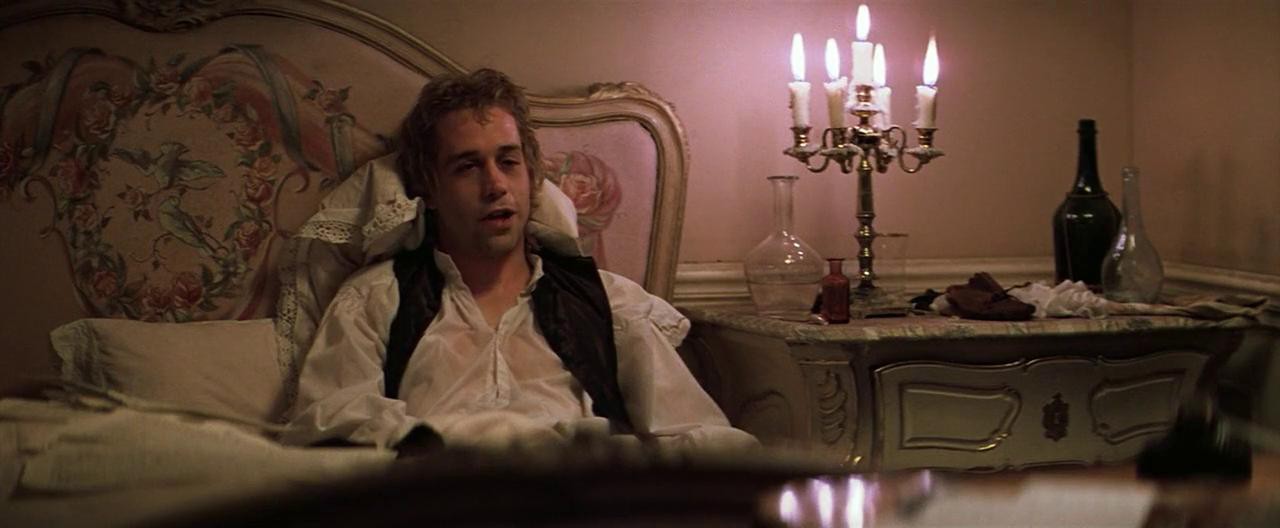 |
| Mozart spends his final day on his deathbed with Salieri at the foot, helping him to compose the requiem. (src) |
However, the worst thing that Salieri does is commission a requiem
from Mozart, with the intention of killing him and possessing the requiem as
his own. By the time Mozart’s final days come around, when he’s desperately
ill, him and Salieri are incredibly close, and Salieri is helping Mozart finish
the requiem. But then Mozart dies, and the requiem goes unfinished.
This, of course, is the straw that broke the camel’s back for
Salieri. He sees this as a damnation from God, that He would kill Mozart, his
mouthpiece, just to scorn Salieri. At this point in the film, it is revealed
that Salieri is (rightfully) in a madhouse, and the film ends on a rolling shot
of Salieri passing the other inmates, professing himself the king of all
mediocrity.
Obviously, the music is incredibly because Mozart’s work was and
is incredible. All but four of the songs in the film are Mozart’s compositions.
The music is perfectly attuned to the movie; each piece is carefully placed and
attuned to the plotline at each point. The operas are impressive, and hearing
Mozart’s music as if it were new is an incredibly enriching experience. I would
recommend you listen to the soundtrack of the film below next time you study.
- Le Nozze di Figaro (The Marriage of Figaro), K492, Act IV, Ah Tutti Contenti (1786)
- Don Giovanni, K527, A Cenar Teco, Da Qual Tremore Insolito... (1787)
- Axur, Re d'Ormus: Finale (1788)
- Die Entführung aus dem Serail (Abduction from the Seraglio), K384, Marten Aller Arten (1782)
- Die Zauberflöte (The Magic Flute), K620, Aria No. 14, Der Holle Rache Kocht (1791)
- Concerto for Piano in E Flat Major, K482, 3rd Movement, Allegro (1782-86)
- Concerto for Piano in D Minor, K466 (1782-86)
- Symphony No. 25 in G Minor, K183: 1st Movement (1773)
- Lacrimosa, Requiem Mass in D, K626
- Harpsichord Piece in F Major, K33B
- Adagio and Rondo for Glass Harmonica, Flute, Oboe, Viola and Cello, K617 (1791)
- Confutatis, Requiem Mass in D, K 626
- Serenade K361 Gran Partita for 13 Wind Instruments: Adagio
- Le Nozze di Figaro (The Marriage of Figaro), K.492: Act 1 - Non Più Andrai (Overture)
- A Little Night Music Serenade in G for Strings 'Eine Kleine Nachtmusik', K.525, 1st Movement
- Die Entführung aus dem Serail (Abduction from the Seraglio), K384: Turkish Final
- Mass in C Minor, K. 427: Kyrie
- Concerto for Flute and Harp, K. 299 2nd Movement
- Allegro Moderato from Symphony No. 29 in A Major, K. 201
- Concerto No. 10 for Two Pianos and Orchestra in E Flat Minor (K. 365) 3rd Movement
- Allegro Maestoso from Sinfonia Concertante for Violin, Viola And Orchestra in E-flat Major, K364
- Piano Concerto No. 15 in B-Flat, K450: III. Allegro
- Ich Möchte Wohl Der Kaiser Sein (K539)
- Die Zauberflöte (The Magic Flute) Act 2 - Pa-Pa-Pa-Pa-Pa-Pa-Papagena!
- Die Zauberflöte (The Magic Flute) Act 2 - Ein Mädchen Oder Weibchen
- Six German Dances, K509: No. 1 in D Major
- Don Giovanni, K527: Overture
- Rex Tremendae Majestatis, Requiem, K626
- Le Nozze di Figaro (The Marriage of Figaro), K.492 /Act I: Duettino: Cinque...Dieci...Venti
- Die Entführung aus dem Serail (Abduction from the Seraglio), K384 Act I, Singt dem Grossen Bassa Lieder
- Le Nozze di Figaro (The Marriage of Figaro), K.492 /Act III: Finale: Amanti Costanti (Ecco la Marcia)
- Die Entführung aus dem Serail (Abduction from the Seraglio), K384 Act II: Duet: Vivat Bacchus! Bacchus Lebe!
- Die Zauberflöte (The Magic Flute), K620/Act I: Overture
- Dies Irae, Requiem Mass in D, K 626
- Introitus, Requiem Mass in D, K 626
- Don Giovanni, K527: Act II, Commendatore Scene
- Don Giovanni, K527: Act I, La Ci Darem La Mano
If you felt like following along while you watched the movie, here's a record of the music used scene by scene.
THINGS TO THINK ABOUT:
Do you believe in God? Just kidding, don't answer that.
Do you think religion can move beyond faith to insanity?
Do you like Mozart better than Beethoven (I don't).

WOW thats a lot of music haha, however I loved learning about it when I was younger, and still occassionally listen to classical music when I need to destress. I think relgion can move beyond faith to insanity. I like both mozart and beethoven, however i think if I were to have to choose it would be beethoven
ReplyDeleteHonestly, Mozart isn't someone who I really think about often in terms of world changing people. I forget that his music was more than groundbreaking. This movie sounds really interesting and to see it from an opponent's prospective lends to whole new viewpoint as opposed to it being told from Mozart's point of view.
ReplyDeleteI really want to watch this movie now. It sounds like an interesting way to tell the story of Mozart's life.
ReplyDeleteI feel a lot of people hide behind religion as an excuse to act inexcusibly, through misinterpretations of whichever scripture they're reading. On that note, I feel that people can draw their inspiration from something they feel is higher than themselves, and can create beautiful work. Definitely makes me want to see this movie! (And yes Mozart was 100000% better than Beethoven)
ReplyDelete